

How Fully Does Updike Draw The Character Of Sammy?
| John Updike | |
|---|---|
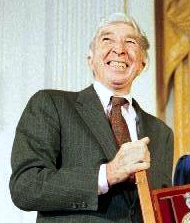
 Updike at the PEN Congress, colorized | |
| Born | John Hoyer Updike (1932-03-eighteen)March 18, 1932 Reading, Pennsylvania, United States |
| Died | January 27, 2009(2009-01-27) (aged 76) Danvers, Massachusetts, The states |
| Occupation |
|
| Genre | Literary realism |
| Notable works | Rabbit Angstrom novels Henry Bech stories The Witches of Eastwick |
| Signature |  |
John Hoyer Updike (March eighteen, 1932 – January 27, 2009) was an American novelist, poet, brusque-story author, art critic, and literary critic. Ane of only four writers to win the Pulitzer Prize for Fiction more than in one case (the others being Booth Tarkington, William Faulkner, and Colson Whitehead), Updike published more than twenty novels, more than than a dozen brusk-story collections, likewise equally poetry, art and literary criticism and children'due south books during his career.
Hundreds of his stories, reviews, and poems appeared in The New Yorker starting in 1954. He too wrote regularly for The New York Review of Books. His nigh famous piece of work is his "Rabbit" serial (the novels Rabbit, Run; Rabbit Redux; Rabbit Is Rich; Rabbit at Rest; and the novella Rabbit Remembered), which chronicles the life of the middle-form everyman Harry "Rabbit" Angstrom over the course of several decades, from young adulthood to expiry. Both Rabbit Is Rich (1982) and Rabbit at Rest (1990) were recognized with the Pulitzer Prize.
Describing his subject as "the American small town, Protestant middle form", Updike was recognized for his careful craftsmanship, his unique prose style, and his prolific output – he wrote on average a book a year. Updike populated his fiction with characters who "frequently experience personal turmoil and must respond to crises relating to religion, family obligations, and marital infidelity".[2]
His fiction is distinguished by its attention to the concerns, passions, and suffering of average Americans, its accent on Christian theology, and its preoccupation with sexuality and sensual detail. His piece of work has attracted significant critical attention and praise, and he is widely considered one of the great American writers of his time.[iii] Updike's highly distinctive prose style features a rich, unusual, sometimes arcane vocabulary as conveyed through the eyes of "a wry, intelligent authorial voice that describes the concrete world extravagantly while remaining squarely in the realist tradition".[4] He described his mode as an attempt "to give the mundane its beautiful due".[5]
Early on life and education [edit]

Boyhood home in Shillington
Updike was born in Reading, Pennsylvania, the just kid of Linda Grace (née Hoyer) and Wesley Russell Updike, and was raised in the nearby small town of Shillington.[6] The family subsequently moved to the unincorporated village of Plowville. His mother's attempts to become a published writer impressed the young Updike. "One of my earliest memories", he later recalled, "is of seeing her at her desk ... I admired the writer'due south equipment, the typewriter eraser, the boxes of clean paper. And I recall the brown envelopes that stories would go off in—and come dorsum in."[vii]
These early years in Berks County, Pennsylvania, would influence the surroundings of the Rabbit Angstrom tetralogy, too every bit many of his early novels and short stories.[8] Updike graduated from Shillington High School as co-valedictorian and class president in 1950 and received a full scholarship to Harvard College, where he was the roommate of Christopher Lasch during their first year.[9] Updike had already received recognition for his writing equally a teenager by winning a Scholastic Art & Writing Award,[10] and at Harvard he soon became well known among his classmates as a talented and prolific contributor to The Harvard Lampoon, of which he was president.[8] He studied with dramatist Robert Chapman, the manager of Harvard'south Loeb Drama Heart.[11] He graduated summa cum laude in 1954 with a caste in English language and was elected to Phi Beta Kappa.[8]
Upon graduation, Updike attended the Ruskin School of Drawing and Fine Art at the Academy of Oxford with the ambition of becoming a cartoonist.[12] After returning to the United states, Updike and his family moved to New York, where he became a regular contributor to The New Yorker. This was the offset of his professional person writing career.[eight]
Career as a writer [edit]
1950s [edit]
Updike stayed at The New Yorker equally a full staff writer for only two years, writing "Talk of the Town" columns and submitting poetry and short stories to the mag. In New York, Updike wrote the poems and stories that came to fill his early books like The Carpentered Hen (1958) and The Aforementioned Door (1959). These works were influenced by Updike's early on engagement with The New Yorker.[8] This early work besides featured the influence of J. D. Salinger ("A&P"); John Cheever ("Snowing in Greenwich Village"); and the Modernists Marcel Proust, Henry Light-green, James Joyce, and Vladimir Nabokov.[8]
During this fourth dimension, Updike underwent a profound spiritual crisis. Suffering from a loss of religious organized religion, he began reading Søren Kierkegaard and the theologian Karl Barth. Both deeply influenced his ain religious beliefs, which in turn figured prominently in his fiction.[8] Updike remained a believing Christian for the rest of his life.[13]
1960s–1970s [edit]
Later, Updike and his family relocated to Ipswich, Massachusetts. Many commentators, including a columnist in the local Ipswich Chronicle, asserted that the fictional town of Tarbox in Couples was based on Ipswich. Updike denied the suggestion in a letter to the paper.[14] Impressions of Updike's day-to-24-hour interval life in Ipswich during the 1960s and 1970s are included in a letter to the aforementioned paper published before long subsequently Updike's death and written by a friend and contemporary.[15] In Ipswich, Updike wrote Rabbit, Run (1960), on a Guggenheim Fellowship, and The Centaur (1963), two of his almost acclaimed and famous works; the latter won the National Book Award.[16]
Rabbit, Run featured Harry "Rabbit" Angstrom, a former loftier schoolhouse basketball star and eye-class paragon who would become Updike'southward almost enduring and critically acclaimed graphic symbol. Updike wrote three boosted novels about him. Rabbit, Run was featured in Time 's All-TIME 100 Greatest Novels.[17]
Curt stories [edit]
Updike's career and reputation were nurtured and expanded by his long association with The New Yorker, which published him frequently throughout his career, despite the fact that he had departed the magazine's employment after only two years. Updike'southward memoir indicates that he stayed in his "corner of New England to give its domestic news" with a focus on the American home from the point of view of a male author.[18] Updike's contract with the magazine gave it right of starting time offer for his brusque-story manuscripts, but William Shawn, The New Yorker's editor from 1952 to 1987, rejected several as too explicit.[19] [xx] [21]
The Maple brusk stories, nerveless in Too Far To Go (1979), reflected the ebb and menses of Updike's first spousal relationship; "Separating" (1974) and "Here Come the Maples" (1976) related to his divorce. These stories also reflect the role of alcohol in 1970s America.[22] They were the basis for the boob tube moving picture also called Too Far To Go, broadcast by NBC in 1979.
Updike's brusque stories were nerveless in several volumes published past Alfred A. Knopf over five decades. In 2022, the Library of America issued a two-volume boxed edition of 186 stories under the title The Collected Stories.[23]
Novels [edit]
In 1971, Updike published a sequel to Rabbit, Run called Rabbit Redux, his response to the 1960s; Rabbit reflected much of Updike's resentment and hostility towards the social and political changes that beset the The states during that time.[24]
Updike's early Olinger flow was set in the Pennsylvania of his youth; information technology concluded around 1965 with the lyrical Of the Farm.
After his early on novels, Updike became near famous for his chronicling infidelity, adultery, and marital unrest, particularly in suburban America; and for his controversial delineation of the confusion and freedom inherent in this breakdown of social mores. [25] He once wrote that it was "a subject which, if I accept not exhausted, has exhausted me". The nearly prominent of Updike's novels of this vein is Couples (1968), a novel about adultery in a small fictional Massachusetts town called Tarbox. It garnered Updike an advent on the cover of Time magazine with the headline "The Adulterous Social club". Both the mag article and, to an extent, the novel struck a chord of national concern over whether American society was abandoning all social standards of carry in sexual matters.
The Coup (1978), a lauded[26] novel about an African dictatorship inspired by a visit he made to Africa, found Updike working in new territory.
1980s–2000s [edit]
In 1980, he published some other novel featuring Harry Angstrom, Rabbit Is Rich, which won the National Volume Laurels,[27] the National Book Critics Circle Award, and the Pulitzer Prize for Fiction—all 3 major American literary prizes. The novel found "Rabbit the fat and happy owner of a Toyota dealership".[8] Updike found it difficult to finish the book, because he was "having and then much fun" in the imaginary county Rabbit and his family inhabited.[24]
Afterward writing Rabbit Is Rich, Updike published The Witches of Eastwick (1984), a playful novel well-nigh witches living in Rhode Island. He described it as an attempt to "brand things right with my, what shall we call them, feminist detractors".[28] One of Updike'due south about pop novels, it was adapted as a film and included on Harold Blossom's list of canonical 20th-century literature (in The Western Canon).[29] In 2008 Updike published The Widows of Eastwick, a render to the witches in their quondam age. It was his last published novel.
In 1986, he published the unconventional novel Roger'south Version, the 2nd book of the then-called Red Letter trilogy, near an attempt to prove God's existence using a computer plan. Author and critic Martin Amis called it a "well-nigh-masterpiece".[30] The novel S. (1989), uncharacteristically featuring a female protagonist, ended Updike's reworking of Hawthorne'southward Scarlet Letter.[eight]
Updike enjoyed working in series; in addition to the Rabbit novels and the Maples stories, a recurrent Updike alter ego is the moderately well-known, unprolific Jewish novelist and eventual Nobel laureate Henry Bech, chronicled in three comic short-story cycles: Bech, a Book (1970), Bech Is Back (1981) and Bech at Bay: A Quasi-Novel (1998). These stories were compiled as The Complete Henry Bech (2001) by Everyman's Library. Bech is a comical and self-witting antithesis of Updike'south own literary persona: Jewish, a Earth War 2 veteran, reclusive, and unprolific to a mistake.[31]
In 1990, he published the last Rabbit novel, Rabbit at Rest, which won the Pulitzer Prize and the National Volume Critics Circle Honor. Over 500 pages long, the novel is among Updike's most historic. In 2000, Updike included the novella Rabbit Remembered in his drove Licks of Honey, drawing the Rabbit saga to a shut. His Pulitzers for the terminal two Rabbit novels make Updike one of only 4 writers to accept won ii Pulitzer Prizes for Fiction, the others being William Faulkner, Booth Tarkington, and Colson Whitehead.
In 1995, Lowest's Library nerveless and canonized the four novels every bit the omnibus Rabbit Angstrom; Updike wrote an introduction in which he described Rabbit as "a ticket to the America all around me. What I saw through Rabbit's optics was more worth telling than what I saw through my own, though the difference was often slight."[32] Updike later called Rabbit "a brother to me, and a proficient friend. He opened me up as a author."[33]
After the publication of Rabbit at Rest, Updike spent the rest of the 1990s and early 2000s publishing novels in a broad range of genres; the work of this period was oft experimental in nature.[eight] These styles included the historical fiction of Memories of the Ford Administration (1992), the magical realism of Brazil (1994), the scientific discipline fiction of Toward the Terminate of Time (1997), the postmodernism of Gertrude and Claudius (2000), and the experimental fiction of Seek My Face up (2002).
In the midst of these, he wrote what was for him a more conventional novel, In the Beauty of the Lilies (1996), a historical saga spanning several generations and exploring themes of religion and cinema in America. It is considered the most successful novel of Updike'due south late career.[viii] Some critics have predicted that posterity may consider the novel a "tardily masterpiece disregarded or praised past rote in its day, only to exist rediscovered by another generation",[34] while others idea it overlong and depressing.[ citation needed ] In Villages (2004), Updike returned to the familiar territory of infidelities in New England. His 22nd novel, Terrorist (2006), the story of a fervent young extremist Muslim in New Bailiwick of jersey, garnered media attention but little critical praise.[8]
In 2003, Updike published The Early Stories, a big collection of his short fiction spanning the mid-1950s to the mid-1970s. More than 800 pages long, with over i hundred stories, it has been called "a richly episodic and lyrical Bildungsroman ... in which Updike traces the trajectory from boyhood, college, married life, fatherhood, separation and divorce".[8] It won the PEN/Faulkner Honour for Fiction in 2004.[35] This lengthy volume notwithstanding excluded several stories found in his curt-story collections of the same flow.
Updike worked in a broad assortment of genres, including fiction, poetry (most of it compiled in Collected Poems: 1953–1993, 1993), essays (collected in 9 divide volumes), a play (Buchanan Dying, 1974), and a memoir (Self-Consciousness, 1989).
Updike's assortment of awards includes ii Pulitzer Prizes for Fiction, two National Book Awards, three National Book Critics Circumvolve awards, the 1989 National Medal of Arts, the 2003 National Humanities Medal, and the Rea Award for the Brusk Story for outstanding accomplishment. The National Endowment for the Humanities selected Updike to present the 2008 Jefferson Lecture, the U.Southward. government'south highest humanities accolade; Updike's lecture was titled "The Clarity of Things: What Is American about American Fine art".[36] [37]
At the cease of his life, Updike was working on a novel about St. Paul and early Christianity.[38] Upon his decease, The New Yorker published an appreciation by Adam Gopnik of Updike'due south lifetime association with the magazine, calling him "one of the greatest of all modern writers, the get-go American writer since Henry James to go himself fully expressed, the man who broke the expletive of incompleteness that had haunted American writing".
Personal life and death [edit]
Updike married Mary Entwistle Pennington, an art student at Radcliffe College, in 1953, while he was still a educatee at Harvard. She accompanied him to Oxford, England, where she attended art school and where their first child, Elizabeth, was born in 1955. The couple had iii more children together: writer David (built-in 1957), artist Michael (born 1959) and creative person Miranda (born 1960). They divorced in 1974. Updike had vii grandsons.
In 1977 Updike married Martha Ruggles Bernhard, with whom he lived for more than than thirty years in Beverly Farms, Massachusetts. He died of lung cancer at a hospice in Danvers, Massachusetts, on January 27, 2009, at the age of 76.[39] [40]
Poesy [edit]
Updike published viii volumes of verse over his career, including his first book The Carpentered Hen (1958), and one of his last, the posthumous Endpoint (2009). The New Yorker published excerpts of Endpoint in its March sixteen, 2009 upshot. Much of Updike'south poetical output was recollected in Knopf's Collected Poems (1993). He wrote that "I began as a writer of lite verse, and have tried to carry over into my serious or lyric verse something of the strictness and liveliness of the lesser course."[41] The poet Thomas 1000. Disch noted that because Updike was such a well-known novelist, his poetry "could be mistaken as a hobby or a foible"; Disch saw Updike's light verse instead as a verse of "epigrammatical lucidity".[42] His poetry has been praised for its engagement with "a variety of forms and topics", its "wit and precision", and for its delineation of topics familiar to American readers.[41]
British poet Gavin Ewart praised Updike for the metaphysical quality of his poetry and for his power "to make the ordinary seem strange", and called him ane of the few modern novelists capable of writing proficient poetry.[43] Reading Endpoint aloud, the critic Charles McGrath claimed that he found "another, deeper music" in Updike'south verse, finding that Updike'south wordplay "smooths and elides itself" and has many subtle "audio effects".[44] John Keenan, who praised the collection Endpoint as "beautiful and poignant", noted that his poetry'southward engagement with "the everyday world in a technically achieved way seems to count against him".[45]
Literary criticism and art criticism [edit]
Updike was besides a critic of literature and art, ane oftentimes cited every bit one of the best American critics of his generation.[46] In the introduction to Picked-Upwardly Pieces, his 1975 drove of prose, he listed his personal rules for literary criticism:

i. Endeavour to understand what the author wished to do, and do not arraign him for not achieving what he did not attempt.
2. Give plenty direct quotation—at least i extended passage—of the book'south prose then the review's reader can form his ain impression, tin become his own taste.
3. Confirm your description of the volume with quotation from the volume, if only phrase-long, rather than proceeding past fuzzy précis.
4. Go easy on plot summary, and do not give away the ending.
five. If the book is judged scarce, cite a successful example along the same lines, from the writer's œuvre or elsewhere. Try to understand the failure. Sure it's his and not yours?
To these concrete v might exist added a vaguer 6th, having to do with maintaining a chemical purity in the reaction between product and appraiser. Exercise non accept for review a book you are predisposed to dislike, or committed by friendship to similar. Do non imagine yourself a caretaker of whatsoever tradition, an enforcer of whatsoever party standards, a warrior in any ideological battle, a corrections officer of whatsoever kind. Never, never ... try to put the author "in his identify," making of him a pawn in a contest with other reviewers. Review the book, not the reputation. Submit to whatever spell, weak or strong, is being cast. Better to praise and share than blame and ban. The communion between reviewer and his public is based upon the presumption of certain possible joys of reading, and all our discriminations should curve toward that cease.[47]
He reviewed "well-nigh every major writer of the 20th century and some 19th-century authors", typically in The New Yorker, always trying to make his reviews "animated".[48] He also championed immature writers, comparison them to his ain literary heroes including Vladimir Nabokov and Marcel Proust.[49] Practiced reviews from Updike were ofttimes seen as a pregnant achievement in terms of literary reputation and even sales; some of his positive reviews helped jump-starting time the careers of such younger writers as Erica Jong, Thomas Mallon and Jonathan Safran Foer.[fifty]
Bad reviews by Updike sometimes acquired controversy,[51] every bit when in late 2008 he gave a "damning" review of Toni Morrison's novel A Mercy.[52] [53]
Updike was praised for his literary criticism'south conventional simplicity and profundity, for existence an aestheticist critic who saw literature on its ain terms, and for his longtime commitment to the practice of literary criticism.[54]
Much of Updike's art criticism appeared in The New York Review of Books, where he often wrote about American art.[55] His art criticism involved an aestheticism similar that of his literary criticism.[54]
Updike's 2008 Jefferson Lecture, "The Clarity of Things: What's American About American Fine art?", dealt with the uniqueness of American art from the 18th century to the 20th.[56] In the lecture he argued that American art, until the expressionist movement of the 20th century in which America declared its creative "independence", is characterized by an insecurity not found in the creative tradition of Europe.
In Updike's own words:[36]
Ii centuries after Jonathan Edwards sought a link with the divine in the beautiful clarity of things, William Carlos Williams wrote in introducing his long poem Paterson that "for the poet there are no ideas just in things." No ideas simply in things. The American artist, starting time built-in into a continent without museums and art schools, took Nature as his simply instructor, and things as his principal study. A bias toward the empirical, toward the evidential object in the numinous fullness of its being, leads to a certain lininess, equally the artist intently maps the visible in a New World that feels surrounded past chaos and emptiness.[56]
Critical reputation and manner [edit]
He is certainly one of the not bad American novelists of the 20th century.
—Martin Amis[57]
Updike is considered i of the greatest American fiction writers of his generation.[58] He was widely praised every bit America'due south "final truthful man of messages", with an immense and far-reaching influence on many writers.[50] The excellence of his prose style is best-selling fifty-fifty past critics skeptical of other aspects of Updike'south work.[four] [59]
Several scholars have chosen attention to the importance of identify, and particularly of southeast Pennsylvania, in Updike's life and work. Bob Batchelor has described "Updike'south Pennsylvania sensibility" every bit one with profound reaches that transcend fourth dimension and place, such that in his writing, he used "Pennsylvania as a character" that went beyond geographic or political boundaries.[60] SA Zylstra has compared Updike's Pennsylvania to Faulkner's Mississippi: "As with the Mississippi of Faulkner's novels, the world of Updike's novels is fictional (as are such towns as Olinger and Brewer), while at the aforementioned fourth dimension it is recognizable every bit a particular American region."[61] Sanford Pinsker observes that "Updike e'er felt a bit out of place" in places like "Ipswich, Massachusetts, where he lived for near of his life. In his heart—and, more important, in his imagination—Updike remained a staunchly Pennsylvania boy."[62] Similarly, Sylvie Mathé maintains that "Updike's well-nigh memorable legacy appears to be his homage to Pennsylvania."[63]
Critics emphasize his "inimitable prose style" and "rich clarification and linguistic communication", often favorably compared to Proust and Nabokov.[four] Some critics consider the fluency of his prose to exist a mistake, questioning the intellectual depth and thematic seriousness of his piece of work given the smooth of his language and the perceived lightness of his themes, while others criticized Updike for misogynistic depictions of women and sexual relationships.[4]
Other critics argue that Updike's "dumbo vocabulary and syntax functions as a distancing technique to mediate the intellectual and emotional involvement of the reader".[4] On the whole, however, Updike is extremely well regarded every bit a writer who mastered many genres, wrote with intellectual vigor and a powerful prose style, with "shrewd insight into the sorrows, frustrations, and banality of American life".[4]
Updike's character Rabbit Angstrom, the protagonist of the series of novels widely considered his magnum opus, has been said to have "entered the pantheon of point American literary figures", forth with Huckleberry Finn, Jay Gatsby, Holden Caulfield and others.[64] A 2002 list by Book mag of the 100 Best Fictional Characters Since 1900 listed Rabbit in the elevation five.[65] The Rabbit novels, the Henry Bech stories, and the Maples stories have been canonized by Everyman's Library.[66]
After Updike's death, Harvard'due south Houghton Library acquired his papers, manuscripts, and letters, naming the collection the John Updike Archive.[67] 2009 too saw the founding of the John Updike Order,[68] a group of scholars dedicated to "awakening and sustaining reader interest in the literature and life of John Updike, promoting literature written by Updike, and fostering and encouraging critical responses to Updike's literary works". The Society will begin publishing The John Updike Review, a periodical of critical scholarship in the field of Updike studies. The John Updike Gild Start Biennial Conference took place in 2022 at Alvernia University.[69]
Eulogizing Updike in January 2009, the British novelist Ian McEwan wrote that Updike's "literary schemes and pretty conceits touched at points on the Shakespearean", and that Updike'southward death marked "the end of the golden historic period of the American novel in the 20th century's second one-half".
McEwan said the Rabbit serial is Updike's "masterpiece and volition surely be his monument", and ended:
Updike is a master of effortless motion—between 3rd and first person, from the metaphorical density of literary prose to the demotic, from specific detail to wide generalisation, from the actual to the numinous, from the scary to the comic. For his own item purposes, Updike devised for himself a mode of narration, an intense, present tense, gratuitous indirect way, that tin can jump upwards, whenever it wants, to a God's-heart view of Harry, or the view of his put-upon married woman, Janice, or victimised son, Nelson. This advisedly crafted bamboozlement permits here assumptions near evolutionary theory, which are more than Updike than Harry, and comically sweeping notions of Jewry, which are more Harry than Updike. This is at the heart of the tetralogy'south achievement. Updike one time said of the Rabbit books that they were an do in point of view. This was typically self-deprecating, but contains an important grain of truth. Harry's teaching extends no further than high schoolhouse, and his view is further limited by a range of prejudices and a stubborn, combative spirit, all the same he is the vehicle for a one-half-million-word meditation on postwar American anxiety, failure and prosperity. A mode had to be devised to make this possible, and that involved pushing beyond the bounds of realism. In a novel similar this, Updike insisted, you accept to be generous and allow your characters eloquence, "and not chop them downwards to what you think is the right size."[lxx]
Jonathan Raban, highlighting many of the virtues that accept been ascribed to Updike'due south prose, called Rabbit at Rest "one of the very few mod novels in English ... that ane can set beside the work of Dickens, Thackeray, George Eliot, Joyce, and non feel the draft ... Information technology is a volume that works by a steady accumulation of a mass of vivid details, of shades and nuances, of the byplay betwixt one sentence and the side by side, and no short review tin can properly honor its intricacy and richness."[71]
The novelist Philip Roth, considered 1 of Updike'due south chief literary rivals,[72] wrote, "John Updike is our time's greatest man of letters, as bright a literary critic and essayist every bit he was a novelist and short story author. He is and always will exist no less a national treasure than his 19th-century forerunner, Nathaniel Hawthorne."[64]
The noted critic James Wood called Updike "a prose author of groovy dazzler, simply that prose confronts ane with the question of whether dazzler is enough, and whether beauty ever conveys all that a novelist must convey".[73] In a review of Licks of Dearest (2001), Wood concluded that Updike's "prose trusses things in very pretty ribbons" but that in that location often exists in his work a "difficult, coarse, primitive, misogynistic worldview". Woods both praised and criticized Updike's language for having "an essayistic saunter; the language lifts itself up on pretty hydraulics, and hovers slightly above its subjects, by and large a little also accomplished and a little too abstruse". According to Wood, Updike is capable of writing "the perfect sentence" and his fashion is characterized past a "frail deferral" of the sentence. Of the beauty of Updike'due south language and his faith in the ability of language that floats to a higher place reality, Wood wrote:
For some fourth dimension at present Updike'south language has seemed to encode an almost theological optimism nearly its chapters to refer. Updike is notably unmodern in his impermeability to silence and the interruptions of the abyss. For all his fabulous Protestantism, both American Puritan and Lutheran-Barthian, with its cold glitter, its insistence on the aching gap between God and His creatures, Updike seems less like Hawthorne than Balzac, in his unstopping and limitless energy, and his cheerfully professional person belief that stories can be continued; the very form of the Rabbit books—here extended a further instance—suggests continuance. Updike does not announced to believe that words ever fail us—'life's gallant, battered ongoingness ', indeed—and part of the difficulty he has run into, late in his career, is that he shows no willingness, verbally, to acknowledge silence, failure, interruption, loss of faith, despair and and then on. Supremely, better than almost any other contemporary writer, he can always draw these feelings and states; just they are non inscribed in the language itself. Updike'south language, for all that it gestures towards the usual range of human disappointment and collapse, testifies instead to its ain uncanny success: to a conventionalities that the globe can always be brought out of its cloudiness and fabricated articulate in a fair season.[74]
In directly contrast to Wood's evaluation, the Oxford critic Thomas Karshan asserted that Updike is "intensely intellectual", with a fashion that constitutes his "way of thought" not merely "a set of dainty curlicues". Karshan calls Updike an inheritor of the "traditional office of the epic writer". Co-ordinate to Karshan, "Updike'south writing picks upwards one voice, joins its cadency, and moves on to another, like Rabbit himself, driving south through radio zones on his flying abroad from his wife and kid."
Disagreeing with Wood's critique of Updike's alleged over-stylization, Karshan evaluates Updike'south language every bit convincingly naturalistic:
Updike's sentences at their frequent all-time are not a complacent expression of faith. Rather, like Proust's sentences in Updike's description, they "seek an essence so fine the search itself is an deed of faith." Updike aspires to "this sense of self-qualification, the kind of timid reverence towards what exists that Cézanne shows when he grapples for the shape and shade of a fruit through a mist of fragile stabs." Their hesitancy and self-qualification ascend equally they meet obstacles, readjust and laissez passer on. If life is bountiful in New England, it is also evasive and hands missed. In the stories Updike tells, marriages and homes are made only to exist broken. His descriptiveness embodies a promiscuous love for everything in the globe. But honey is precarious, Updike is always saying, since it thrives on obstructions and makes them if it cannot find them.[59]
Harold Bloom in one case called Updike "a minor novelist with a major style. A quite beautiful and very considerable stylist ... He specializes in the easier pleasures."[75] Bloom also edited an important collection of critical essays on Updike in 1987, in which he concluded that Updike possessed a major style and was capable of writing cute sentences which are "beyond praise"; notwithstanding, Blossom went on, "the American sublime will never touch his pages".[76]
On The Dick Cavett Show in 1981, the novelist and short-story author John Cheever was asked why he did not write volume reviews and what he would say if given the chance to review Rabbit Is Rich. He replied:
The reason I didn't review the book is that it maybe would take taken me 3 weeks. My appreciation of it is that diverse and that complicated ... John is perhaps the but contemporary writer who I know now who gives me the sense of the fact that life is—the life that we perform is in an environment that enjoys a grandeur that escapes us. Rabbit is very much possessed of a paradise lost, of a paradise known fleetingly perhaps through erotic dear and a paradise that he pursues through his children. It's the vastness of John's scope that I would have described if I could through a review.[77]
The Fiction Circus, an online and multimedia literary mag, called Updike one of the "four Corking American Novelists" of his time along with Philip Roth, Cormac McCarthy, and Don DeLillo, each jokingly represented as a sign of the Zodiac. Furthermore, Updike was seen as the "all-time prose writer in the world", like Nabokov before him. But in contrast to many literati and institution obituaries, the Circus asserted that nobody "thought of Updike as a vital author".[78]
Adam Gopnik of The New Yorker evaluated Updike as "the first American writer since Henry James to become himself fully expressed, the man who broke the curse of incompleteness that had haunted American writing ... He sang similar Henry James, but he saw like Sinclair Lewis. The 2 sides of American fiction—the precise, realist, encyclopedic appetite to go it all in, and the exquisite urge to make writing out of awareness rendered exactly—were both alive in him."[34]
The critic James Wolcott, in a review of Updike's last novel, The Widows of Eastwick (2008), noted that Updike's penchant for observing America's reject is coupled with an affirmation of America'south ultimate claim: "Updike elegises entropy American-style with a resigned, paternal, disappointed affection that distinguishes his fiction from that of grimmer declinists: Don DeLillo, Gore Vidal, Philip Roth. America may have lost its looks and stature, only it was a beauty once, and worth every golden dab of sperm."[79]
Gore Vidal, in a controversial essay in the Times Literary Supplement, professed to have "never taken Updike seriously as a author". He criticizes his political and artful worldview for its "blandness and acceptance of authority in any course". He concludes that Updike "describes to no purpose". In reference to Updike's wide establishment acclaim, Vidal mockingly called him "our good child" and excoriated his declared political conservatism. Vidal ultimately ended, "Updike's work is more and more representative of that polarizing within a state where Authority grows ever more brutal and malign while its hired hands in the media abound ever more than excited as the holy war of the few confronting the many heats up."[80]
Robert B. Silvers, editor of The New York Review of Books, called Updike "1 of the most elegant and coolly observant writers of his generation".[81]
The short-story writer Lorrie Moore, who in one case described Updike equally "American literature's greatest short story writer ... and arguably our greatest writer",[48] reviewed Updike's body of short stories in The New York Review, praising their intricate detail and rich imagery: "his eye and his prose never stammer, even when the world fails to transport its more socially complicated revelations directly his story's fashion".[82]
In a post commemorating his birthday in 2022, blogger and literary critic Christy Potter chosen Updike "... THE Writer, the kind of writer everyone has heard of, the one whose proper noun you lot tin bring upwardly at a party and people who take never read one thing he wrote will still nod their heads knowingly and say, 'Oh yes, John Updike. The author.'"[83]
In Nov 2008, the editors of the Uk's Literary Review magazine awarded Updike their Bad Sex in Fiction Lifetime Achievement Honor, which celebrates "crude, tasteless or ridiculous sexual passages in modern literature".[37]
Themes [edit]
All in all this is the happiest fucking state the world has always seen.
—Rabbit Angstrom.[84]
The primary themes in Updike'south piece of work are religion, sex, and America[85] likewise every bit death.[86] Often he would combine them, frequently in his favored terrain of "the American pocket-size town, Protestant heart class", of which he once said, "I similar middles. It is in middles that extremes disharmonism, where ambiguity restlessly rules."[64]
For example, the pass up of religion in America is chronicled in In the Beauty of the Lilies (1996) alongside the history of cinema, and Rabbit Angstrom contemplates the merits of sex with the married woman of his friend Reverend Jack Eccles while the latter is giving his sermon in Rabbit, Run (1960).
Critics accept often noted that Updike imbued linguistic communication itself with a kind of faith in its efficacy, and that his tendency to construct narratives spanning many years and books—the Rabbit series, the Henry Bech series, Eastwick, the Maples stories—demonstrates a similar religion in the transcendent ability of fiction and language.[74] Updike's novels often human activity every bit dialectical theological debates between the book itself and the reader, the novel endowed with theological beliefs meant to claiming the reader equally the plot runs its course.[3] Rabbit Angstrom himself acts equally a Kierkegaardian Knight of Religion.[viii]
Describing his purpose in writing prose, Updike himself, in the introduction to his Early on Stories: 1953–1975 (2004), wrote that his aim was ever "to give the mundane its beautiful due".[v] Elsewhere he famously said, "When I write, I aim my mind not towards New York Metropolis simply towards a vague spot east of Kansas."[87] Some accept suggested[59] that the "all-time argument of Updike's aesthetic comes in his early memoir 'The Dogwood Tree'" (1962): "Blankness is non emptiness; we may skate upon an intense radiance nosotros do not run across because we come across nothing else. And in fact there is a colour, a repose merely tireless goodness that things at residuum, like a brick wall or a small rock, seem to affirm."[88]
Sexual activity [edit]
Sexual activity in Updike's work is noted for its ubiquity and the reverence with which he described it:
His contemporaries invade the ground with wild Dionysian yelps, mocking both the taboos that would make it forbidden and the lust that drives men to it. Updike tin can be honest almost it, and his descriptions of the sight, taste and texture of women's bodies can be perfect little madrigals.[89]
The critic Edward Champion notes that Updike's prose heavily favors "external sexual imagery" rife with "explicit anatomical detail" rather than descriptions of "internal emotion" in descriptions of sex.[90] In Champion's interview with Updike on The Bat Segundo Show, Updike replied that he perhaps favored such imagery to concretize and make sex "real" in his prose.[90] Some other sexual theme commonly addressed in Updike is adultery, especially in a suburban, middle class setting, most famously in Couples (1968). The Updikean narrator is oft "a man guilty of adultery and abandonment of his family".[91]
United States [edit]
Similarly, Updike wrote about America with a sure nostalgia, reverence, and recognition and celebration of America's broad diverseness. ZZ Packer wrote that in Updike, "in that location seemed a foreign ability to harken both America the Beautiful as well as America the Plain Jane, and the lovely Protestant courage in his fiction and essays, when he decided to show information technology off, was as progressive and enlightened as it was unapologetic."[92]
The Rabbit novels in detail tin can exist viewed, according to Julian Barnes, as "a distraction from, and a glittering confirmation of, the vast bustling ordinariness of American life".[93] But as Updike historic ordinary America, he likewise alluded to its pass up: at times, he was "and so conspicuously disturbed by the downwards spin of America".[94] Adam Gopnik concludes that "Updike's not bad subject field was the American attempt to make full the gap left past organized religion with the materials produced by mass culture. He documented how the death of a credible religious conventionalities has been offset by sex activity and infidelity and movies and sports and Toyotas and family honey and family obligation. For Updike, this effort was blessed, and very about successful."[34]
Updike's novels about America near ever contain references to political events of the fourth dimension. In this sense, they are artifacts of their historical eras, showing how national leaders shape and ascertain their times. The lives of ordinary citizens have place against this wider background.
Decease [edit]
Updike ofttimes wrote about death, his characters providing a "mosaic of reactions" to mortality, ranging from terror to attempts at insulation.[86] In The Poorhouse Off-white (1959), the elderly John Claw intones, "There is no goodness without belief ... And if yous have not believed, at the end of your life you shall know you have cached your talent in the basis of this world and take naught saved, to accept into the next", demonstrating a religious, metaphysical faith present in much of Updike's work.
For Rabbit Angstrom, with his constant musings on mortality, his most-witnessing of his daughter's death, and his often shaky faith, death is more frightening and less obvious in its ramifications. At the end of Rabbit at Rest (1990), though, Rabbit demonstrates a kind of certainty, telling his son Nelson on his deathbed, "... Simply enough. Perchance. Enough." In The Centaur (1963), George Caldwell has no religious religion and is afraid of his cancer.[86] Death tin can also be a sort of unseen terror; it "occurs offstage only reverberates for survivors as an absent presence".[86]
Updike himself also experienced a "crisis over the afterlife", and indeed
many of his heroes shared the same sort of existential fears the writer best-selling he had suffered as a young man: Henry Bech'south business concern that he was 'a fleck of dust condemned to know it is a fleck of dust,' or Colonel Ellelloû's lament that 'nosotros will be forgotten, all of u.s. forgotten.' Their fearfulness of death threatens to make everything they do feel meaningless, and it likewise sends them running afterward God—looking for some reassurance that there is something beyond the familiar, everyday earth with 'its signals and buildings and cars and bricks.'[95]
Updike demonstrated his own fright in some of his more personal writings, including the poem "Perfection Wasted" (1990):
And another regrettable thing almost death
is the ceasing of your own brand of magic ...[96]
In popular culture [edit]
- Updike was featured on the cover of Time twice, on Apr 26, 1968 and once more on October 18, 1982.[97]
- Updike was the subject of a "closed volume test" past Nicholson Baker, titled U and I (1991). Bakery discusses his wish to meet Updike and become his golf partner.[98]
- In 2000, Updike appeared every bit himself in The Simpsons episode "Insane Clown Poppy" at the Festival of Books.
- The chief grapheme portrayed by Eminem in the film eight Mile (2002) is nicknamed "Rabbit" and has some similarities to Rabbit Angstrom.[99] The film's soundtrack has a song titled "Rabbit Run".
- Portraits of Updike fatigued by the American caricaturist David Levine appeared several times in The New York Review of Books.[100]
Bibliography [edit]
See also #External links for links to archives of his essays and reviews in The New Yorker and The New York Review of Books.
Awards [edit]
[101]
- 1959 Guggenheim Fellow
- 1959 National Institute of Arts and Letters Rosenthal Award
- 1964 National Book Honour for Fiction[xvi]
- 1965 Prix du Meilleur Livre Étranger
- 1966 O. Henry Prize
- 1970 Honorary Doctor of Literature from Emerson College
- 1981 National Volume Critics Circumvolve Laurels for Fiction
- 1981 Edward MacDowell Medal
- 1982 Pulitzer Prize for Fiction
- 1982 National Volume Honour for Fiction (hardcover)[27] [a]
- 1982 Union League Society Abraham Lincoln Honor
- 1983 National Book Critics Circle Honour for Criticism
- 1984 National Arts Club Medal of Honour
- 1987 St. Louis Literary Laurels from the Saint Louis University Library Associates[102] [103]
- 1987 Ambassador Book Award
- 1987 Peggy Five. Helmerich Distinguished Author Laurels
- 1988 PEN/Malamud Laurels
- 1989 National Medal of Arts
- 1990 National Book Critics Circumvolve Award for Fiction
- 1991 Pulitzer Prize for Fiction
- 1991 O. Henry Prize
- 1992 Honorary Doctor of Letters from Harvard University
- 1995 William Dean Howells Medal
- 1995 Commandeur de l'Ordre des Arts et des Lettres
- 1997 Ambassador Volume Award
- 1998 Harvard Arts Medal[104]
- 1998 Medal for Distinguished Contribution to American Letters from the National Book Foundation[105]
- 2002 Fitzgerald Award for Achievement in American Literature
- 2003 National Humanities Medal
- 2004 PEN/Faulkner Honour for Fiction
- 2004 Gold Plate Accolade of the American Academy of Achievement[106] [107]
- 2005 Man Booker International Prize nominee
- 2006 Rea Award for the Brusk Story
- 2007 American Academy of Arts and Letters Gilded Medal for Fiction
- 2008 Literary Review Bad Sex in Fiction Lifetime Achievement Laurels
- 2008 Jefferson Lecture
Notes [edit]
- ^ This was the honour for hardcover Fiction.
From 1980 to 1983 in National Volume Award history there were dual awards for hardcover and paperback books in many categories. About of the paperback award-winners were reprints, including the 1982 Fiction.
References [edit]
- ^ "John Updike". Front Row. October 31, 2008. BBC Radio 4. Retrieved January xviii, 2022.
- ^ "John Updike", Encarta, MSN, 2008, retrieved October 31, 2009 .
- ^ a b Schiff, James (Fall 2001). "John Updike'south Rabbit Tetralogy: Mastered Irony in Motion". Christianity and Literature (review). Archived from the original on Apr 6, 2009. Retrieved Jan ix, 2008.
- ^ a b c d e f "John Updike Criticism", ENotes, Contemporary Literary Criticism, 139, 2001 .
- ^ a b Updike, John (2004), The Early on Stories: 1953–1975, Ballantine Books .
- ^ "John Updike Biography and Interview". www.achievement.org. American Academy of Achievement.
- ^ Barrett, Andrea (January fourteen, 1990). "Nibbled at By Neighbors". The New York Times . Retrieved May 7, 2022.
- ^ a b c d eastward f thou h i j k fifty grand northward Boswell, Marshall. "John Updike", The Literary Encyclopedia, March 18, 2004
- ^ Lasch, Christopher. Plainly Mode : A Guide to Written English language. Academy of Pennsylvania Printing, 2002, p. 6.
- ^ Scholastic Inc. Art & Writing Awards, Alumni, http://www.artandwriting.org/who-we-are/alumni/
- ^ Eric Step (October 24, 2000). "Robert Chapman, 81, Playwright And Retired Harvard Professor". The New York Times.
- ^ Heer, Jeet (March 20, 2004), "John Updike'southward animated ambitions", The Guardian .
- ^ "John Updike", Religion and Ideals News Weekly, PBS, no. 812, November 19, 2004 .
- ^ The Ipswich Relate. April 25, 1968. Letter: "Updike 'flatly denies' that Tarbox is Ipswich."
- ^ "John Updike: The Ipswich Connexion". The Ipswich Chronicle. February 9, 2009. Archived from the original on November 11, 2022.
- ^ a b "National Volume Awards – 1964". National Volume Foundation. Retrieved March xi, 2022. (With acceptance speech by Updike and essay by Harold Augenbraum from the Awards 60-year anniversary web log.)
- ^ All-Time 100 Novels
- ^ Gross, Terry (2004). Being square. All I did was ask: Conversations with writers, actors, musicians, and artists (p. 24). New York, NY: Hyperion.
- ^ Menand, Louis (November 24, 2003). "True Story". The New Yorker. ISSN 0028-792X. Retrieved January 24, 2022.
- ^ "William Shawn". The New Yorker.
- ^ "John Updike". The New Yorker.
- ^ Donahue, Peter. "Pouring Drinks and Getting Drunk: The Social and Personal Implications of Drinking in John Updike's Too Far to Go." Studies in Brusk Fiction 33.3 (1996): (p. 362). Ebscohost. Web. March 22, 2022
- ^ https://www.loa.org/books/391-the-collected-stories-boxed-gear up. Retrieved March 14, 2022
- ^ a b Charlie Rose Archived August five, 2009, at the Wayback Machine interview, Oct 24, 1995
- ^ "Bye, King John of Suburbia", New Statesman, Jan 29, 2009
- ^ Updike le Noir | past John Thompson | The New York Review of Books
- ^ a b "National Volume Awards – 1982". National Book Foundation. Retrieved March 11, 2022. (With essays past Amity Gaige and Nancy Werlin from the Awards 60-twelvemonth anniversary web log.)
- ^ Michiko Kakutani, "Books of the Times: 'The Widows of Eastwick'", The New York Times, Oct 19, 2008
- ^ Harold Bloom, The Western Canon: The Books and Schools of the Ages (1994), "The Chaotic Age: The The states," Riverhead Merchandise.
- ^ Martin Amis, "When Amis met Updike ...", The Guardian, February 1, 2009
- ^ Jack De Bellis (ed.), The John Updike Encyclopedia (2000), "Bech, Henry", pp. 52–53.
- ^ John Updike, "Introduction", Rabbit Angstrom (1995), Everyman's Library.
- ^ Charlie Rose interview on YouTube, 1996
- ^ a b c Adam Gopnik, "Postscript: John Updike", The New Yorker, February 9, 2009
- ^ Award Winners—The PEN/Faulkner Laurels for Fiction Archived April 12, 2009, at the Wayback Automobile. Powell's Books, Powells.com
- ^ a b Howard, Jennifer (May 23, 2008). "In Jefferson Lecture, Updike Says American Art Is Known past Its Insecurity". Chronicle of Higher Educational activity.
- ^ a b Tolson, Jay (May 23, 2008). "John Updike on American Art". U.S. News & World Report. Archived from the original on February 2, 2009.
- ^ Updike'southward roots and evolution | Harvard Gazette
- ^ Ancestry.com. Social Security Decease Alphabetize [database on-line]. Provo, UT, USA: Ancestry.com Operations Inc, 2022. Original information: Social Security Administration. Social Security Expiry Index. Social Security Assistants.
- ^ "United states novelist Updike dies of cancer". BBC News. Jan 27, 2009. Retrieved January 28, 2009.
- ^ a b John Updike: The Verse Foundation, archive
- ^ Poets.org: John Updike
- ^ Gavin Ewart, "Making information technology strange", The New York Times, April 28, 1985
- ^ Charles McGrath, "Reading Updike's Last Words, Aloud", The New York Times, April 3, 2009
- ^ John Keenan, "The clarity of Updike's poetry should not obscure its form", The Guardian, March 12, 2009
- ^ James Atlas, "Towards the Transhuman", London Review of Books, February 2, 1984
- ^ "Remembering Updike: The Gospel According to John", The New Yorker online
- ^ a b Mary Rourke, "John Updike dies at 76; Pulitzer-winning author", Los Angeles Times, January 28, 2009
- ^ ZZ Packer, "Remembering Updike", The New Yorker online
- ^ a b Charles McGrath, "John Updike'south Mighty Pen", The New York Times, January 31, 2009
- ^ Alex Carnevale, "Literary Feuds: Toni Morrison is John Updike's Latest Lit-Fit Victim", Oct 2008, Gawker.com
- ^ "Updike takes a swipe at Toni Morrison", The First Post, Oct 29, 2008
- ^ John Updike, "Dreamy Wilderness", The New Yorker, November 3, 2008
- ^ a b Wyatt Mason, "Amid the reviewers: John Updike and the book-review bugaboo", Harper'due south, December 2007
- ^ "John Updike". New York Review of Books. The New York Review of Books. Retrieved Jan xxx, 2022.
- ^ a b John Updike, "The Clarity of Things", National Endowment for the Humanities
- ^ Martin Amis, "He took the novel onto some other plane of intimacy", The Guardian, 28 January 2009
- ^ "What Is the Best Work of American Fiction of the Last 25 Years?" The New York Times, May 21, 2006, "a couple of hundred prominent writers, critics, editors and other literary sages" listed the Rabbit series equally i of the few greatest works of modern American fiction.
- ^ a b c Thomas Karshan, "Batsy", London Review of Books, March 31, 2005
- ^ Batchelor, Bob (April 23, 2022). John Updike: A Disquisitional Biography. Oxford: Praeger. p. 44. ISBN9780313384042.
- ^ Zylstra, SA (1973). "John Updike and the Parabolic Nature of the World". Soundings. 53 (3): 323–337. JSTOR 41177889.
- ^ Pinkser, Sanford (2009). "John Updike, Harry (Rabbit) Angstrom, and I". Sewanee Review. 117 (iii): 492–494. doi:ten.1353/sew.0.0156. S2CID 161771807.
- ^ Mathé, Sylvie (2010). "In Memoriam John Updike (1932-2009): That 'Pennsylvania matter'". Transatlantica (2). doi:10.4000/transatlantica.5074.
- ^ a b c Christopher Lehmann-Haupt, "John Updike, a Lyrical Writer of the Middle Class, Dies at 76", The New York Times, January 28, 2009
- ^ Book magazine, March/April 2002, "100 All-time Fictional Characters since 1900", via NPR
- ^ "Everyman'south Library: Authors", Random House
- ^ Tracy Jan, "Harvard buys Updike archive", Boston World, October 7, 2009
- ^ "The John Updike Order Homepage". The John Updike Order. Retrieved Dec 9, 2009.
- ^ "The John Updike Guild Starting time Biennial Briefing." Archived May 28, 2022, at the Wayback Machine Alvernia Academy. Retrieved December ix, 2009.
- ^ Ian McEwan, "On John Updike", New York Review of Books Vol 56 No iv, 12 March 2009
- ^ Jonathan Raban, The Oxford Book of the Sea (1993), Oxford University Press, pp. 509–517.
- ^ "John Updike: 2008 Jefferson Lecture Archived ane Feb 2009 at the Wayback Automobile", National Endowment for the Humanities
- ^ James Wood, The Broken Estate: Essays on Literature and Belief (2000), "John Updike'south Complacent God", Mod Library, pp. 192.
- ^ a b James Wood, "Gossip in Gilt", London Review of Books, 19 April 2001
- ^ Richard Eder, "The Paris Interviews", The New York Times, Dec 25, 2007.
- ^ Harold Blossom, ed., Modern Critical Views of John Updike, "Introduction," Chelsea Firm, New York, 1987.
- ^ Dick Cavett, "Writers Bloc: When Updike and Cheever Came to Visit", The New York Times, February 13, 2009. Video Oct 14, 1981
- ^ S. Future, "Updike", The Fiction Circus, Jan 27, 2009,
- ^ James Wolcott, "Caretaker/Pallbearer", London Review of Books, Jan 1, 2009
- ^ Gore Vidal, "Rabbit's own couch", Times Literary Supplement, April 26, 1996
- ^ Brand, Madeleine. Robert B. Silvers interview for NPR Remembrances: "John Updike: The Shy Man And Groovy Writer". NPR, Day to 24-hour interval, January 27, 2009
- ^ Lorrie Moore, "Abode Truths", New York Review of Books, Nov twenty, 2003
- ^ Potter, Christy. Unraveling the Mysterious Appeal of John Updike. http://www.ChristytheWriter.com/?p=2611, 2022
- ^ John Updike, Rabbit at Residue (1990), Knopf, pp. 308
- ^ The Economist, "An American subversive", January 29, 2009
- ^ a b c d Jack De Bellis (ed.), "Mortality and Immortality", The John Updike Encyclopedia (2000), pp. 286. See here for many subsequent quotes and citations on decease.
- ^ Robert McCrun, "John Updike was of a generation that inverse the literary landscape irrevocably," The Guardian, February 1, 2009
- ^ John Updike, "The Dogwood Tree", Assorted Prose (1965), Knopf.
- ^ Time, "View from the Catacombs", 26 Apr 1968, pp. 6
- ^ a b The Bat Segundo Show, Evidence #50, John Updike
- ^ Antonya Nelson, "Remembering Updike", The New Yorker online
- ^ ZZ Packer, "Remembering Updike", The New Yorker online
- ^ Julian Barnes, "Remembering Updike", The New Yorker online
- ^ Jack De Bellis (ed.), "More than Matter", The John Updike Encyclopedia (2000), pp. 281.
- ^ Kakutani, Michiko (January 27, 2009), "An Appraisal: A Relentless Updike Mapped America 'due south Mysteries", The New York Times .
- ^ Updike, John (1995), "Perfection Wasted", Collected Poems: 1953–1993, Knopf .
- ^ 26 Apr 1968 Fourth dimension cover Archived February 28, 2009, at the Wayback Motorcar, 18 Oct 1982 Time comprehend Archived September half dozen, 2008, at the Wayback Machine
- ^ Nicholson Bakery, U and I: A Truthful Story, Random House, 1991, Google Books
- ^ ECHO Journal IV/two, Kajikawa, "Review: 8 Mile, "Rap, Rabbit, Rap,"
- ^ "David Levine Gallery". New York Review of Books. The New York Review of Books. Retrieved January 30, 2022.
- ^ All awards listed at The Centaurian Archived February fourteen, 2009, at the Wayback Motorcar Updike homepage, "Awards, Prizes, and Honors", March 17, 2009
- ^ "Website of St. Louis Literary Accolade". Archived from the original on August 23, 2022. Retrieved July 25, 2022.
- ^ Saint Louis University Library Assembly. "Recipients of the Saint Louis Literary Honour". Archived from the original on July 31, 2022. Retrieved July 25, 2022.
- ^ "History of the Harvard Arts Medal". Harvard Academy Part for the Arts. Retrieved February 23, 2022.
- ^ "Distinguished Contribution to American Letters". National Book Foundation. Retrieved March xi, 2022. (With acceptance oral communication by Updike and introduction by Paul LeClerc.)
- ^ "Gold Plate Awardees of the American University of Achievement". www.accomplishment.org. American Academy of Achievement.
- ^ "2004 Acme Highlights Photograph". 2004.
Pulitzer Prize-winning novelist, essayist, and poet John Updike addresses Academy delegates and members.
Further reading and literary criticism [edit]
- Bailey, Peter J., Rabbit (United nations)Redeemed: The Drama of Belief in John Updike's Fiction, Farleigh Dickinson University Press, Madison, New Jersey, 2006.
- Baker, Nicholson, U & I: A Truthful Story, Random House, New York, 1991.
- Batchelor, Bob, John Updike: A Critical Biography, Praeger, California, 2022. ISBN 978-0-31338403-5.
- Begley, Adam, Updike, Harper-Collins Publishers, New York, NY, 2022.
- Ben Hassat, Hedda, Prophets Without Vision: Subjectivity and the Sacred in Contemporary American Writing, Bucknell University Printing, Lewisburg, Pennsylvania, 2000.
- Bloom, Harold, ed., Modern Critical Views of John Updike, Chelsea House, New York, 1987.
- Boswell, Marshall, John Updike'south Rabbit Tetralogy: Mastered Irony in Motion, University of Missouri Press, Columbia, Missouri, 2001.
- Broer, Lawrence, Rabbit Tales: Poetry and Politics in John Updike'south Rabbit Novels, Academy of Alabama Press, Tuscaloosa, Alabama, 2000.
- Burchard, Rachel C., John Updike: Yea Sayings, Southern Illinois University Press, Carbondale, Illinois, 1971.
- Campbell, Jeff H., Updike's Novels: Thorns Spell A Word, Midwestern Country Academy Press, Wichita Falls, Texas, 1988.
- Clarke Taylor, C., John Updike: A Bibliography, Kent State Academy, Kent, Ohio, 1968.
- De Bellis, Jack, John Updike: A Bibliography, 1968–1993, Greenwood Publishing Group, Westport, Connecticut, 1994.
- De Bellis, Jack, John Updike: The Critical Responses to the Rabbit Saga, Greenwood Publishing Group, Westport, Connecticut, 2005.
- De Bellis, Jack, ed., The John Updike Encyclopedia, Greenwood Press, Santa Barbara, California, 2001.
- Detwiler, Robert, John Updike, Twayne, Boston, 1984.
- Findlay, Bill, Interview with John Updike in Hearn, Sheila M. (ed.), Cencrastus No. 15, New Year 1984, pp. 30 - 36, ISSN 0264-0856
- Greiner, Donald, " Don DeLillo, John Updike, and the Sustaining Power of Myth", UnderWords: Perspectives on Don DeLillo'southward Underworld, University of Delaware Press, Newark, Delaware, 2002.
- Greiner, Donald, John Updike's Novels, Ohio Academy Press, Athens, Ohio, 1984.
- Greiner, Donald, The Other John Updike: Poems, Short Stories, Prose, Play, Ohio University Press, Athens, Ohio, 1981.
- Gullette, Margaret Morganroth, "John Updike: Rabbit Angstrom Grows Up", Safe at Last in the Heart Years : The Invention of the Midlife Progress Novel, Backinprint.com, New York, 2001.
- Hamilton, Alice and Kenneth, The Elements of John Updike, William B. Eerdmans Publishing Co., Yard Rapids, Michigan, 1970.
- Hunt, George W., John Updike and the Three Great Hugger-mugger Things: Sex, Organized religion, and Art, William B. Eerdmans Pub. Co., Grand Rapids, Michigan, 1985.
- Karshan, Thomas, " Batsy", London Review of Books, March 31, 2005.
- Luscher, Robert M., John Updike: A Report of the Short Fiction, Twayne, New York, 1993.
- Mazzeno, Laurence Due west. and Sue Norton, eds.,European Perspectives on John Updike, Camden House, 2022.
- McNaughton, William R., ed., Critical Essays on John Updike, GK Hall, Boston, 1982.
- Markle, Joyce B., Fighters and Lovers: Themes in the Novels of John Updike, New York University Press, 1973.
- Mathé, Sylvie, John Updike : La nostalgie de 50'Amérique, Berlin, 2002.
- Miller, D. Quentin, John Updike and the Cold War: Cartoon the Iron Curtain, University of Missouri Press, Columbia, Missouri, 2001.
- Morley, Catherine, "The Bard of Everyday Domesticity: John Updike'south Song for America", The Quest for Epic in Contemporary American Literature, Routledge, New York, 2008.
- Newman, Judie, John Updike, Macmillan, London, 1988.
- O'Connell, Mary, Updike and the Patriarchal Dilemma: Masculinity in the Rabbit Novels, Southern Illinois Academy Press, Carbondale, Illinois, 1996.
- Olster, Stanley, The Cambridge Companion to John Updike, Cambridge University Press, Cambridge, 2006.
- Plath, James, ed., Conversations with John Updike, University Press of Mississippi Press, Jackson, Mississippi, 1994.
- Porter, M. Gilbert, " John Updike's 'A&P': The Institution and an Emersonian Cashier", English Journal 61 (8), pp. 1155–1158, November 1972.
- Pritchard, William, Updike: America'due south Man of Letters, University of Massachusetts Press, Amherst, Massachusetts, 2005.
- Ristoff, Dilvo I., John Updike'due south Rabbit at Rest: Appropriating History, Peter Lang, New York, 1998.'
- Roiphe, Anne, For Rabbit, with Honey and Squalor, Gratis Press, Washington, D.C., 2000.
- Searles, George J., The Fiction of Philip Roth and John Updike, Southern Illinois University Press, Carbondale, Illinois, 1984.
- Schiff, James A., Updike'south Version: Rewriting The Scarlet Letter of the alphabet, Academy of Missouri Printing, Columbia, Missouri, 1992.
- Schiff, James A., United States Author Series: John Updike Revisited, Twayne Publishers, Woodbridge, Connecticut, 1998.
- Tallent, Elizabeth, Married Men and Magic Tricks: John Updike's Erotic Heroes, Creative Arts Book Visitor, Berkeley, California, 1982.
- Tanner, Tony, "A Compromised Environment", City of Words: American Fiction, 1950–1970, Jonathan Cape, London, 1971.
- Thorburn, David and Eiland, Howard, eds., John Updike: A Collection of Critical Essays, Prentice Hall, Englewood Cliffs, New Jersey, 1979.
- Trachtenberg, Stanley, ed., New Essays on Rabbit, Run, Cambridge University Press, Cambridge, 1993.
- Uphaus, Suzanne H., John Updike, Ungar, New York, 1980.
- Vidal, Gore, "Rabbit'due south own burrow", Times Literary Supplement, Apr 26, 1996.
- Wallace, David Foster, "John Updike, Champion Literary Phallocrat, Drops One", New York Observer, Oct 12, 1997.
- Wood, James, "Gossip in Gold", London Review of Books, April 19, 2001.
- Wood, James, "John Updike's Complacent God", The Broken Estate: Essays on Literature and Belief, Modernistic Library, New York, 2000.
- Yerkes, James, John Updike and Religion: The Sense of the Sacred and the Motions of Grace, William B. Eerdmans Publishing Co, Grand Rapids, Missouri, 1999.
External links [edit]
- The John Updike Society
- John Updike collection, Houghton Library, Harvard University
- The Other John Updike Archive, a collection taken from Updike's rubbish and discussed in this article from The Guardian, September 2022, and this commodity from The Atlantic
- Jack De Bellis drove of John Updike at the University of South Carolina
- Column archive at The New York Review of Books
- Cavalcade archive at The New Yorker
- Appearances on C-SPAN
- In Depth interview with Updike, 4 December 2005
- John Updike on Charlie Rose
- John Updike at IMDb
- Works by or about John Updike in libraries (WorldCat catalog)
- Works by John Updike at Open Library

- "John Updike collected news and commentary". The New York Times.
- John Updike collected news and commentary at The Guardian
- Reviews at the London Review of Books
- Stuart Wright Collection: John Updike Papers, 1946–2010 (#1169-023), E Carolina Manuscript Collection, J. Y. Joyner Library, East Carolina University
- Authors and Poets collection at University of Maryland
- Manufactures and interviews
- John Updike, The Fine art of Fiction No. 43, Charles Thomas Samuels, Paris Review, Winter 1968
- "Picked-Up Pieces: A half century of John Updike". The New Yorker, 2009
- The beginnings of John Hoyer Updike, Rootsweb
- Petri Liukkonen. "John Updike". Books and Writers
- John Updike Life & Times, New York Times Books
- The Salon Interview: John Updike, "Equally Close as You Can Get to the Stars", Dwight Garner, Salon.com

Source: https://en.wikipedia.org/wiki/John_Updike
Posted by: kimblenovence.blogspot.com
0 Response to "How Fully Does Updike Draw The Character Of Sammy?"
Post a Comment